Pour Painting

And now for something completely different!

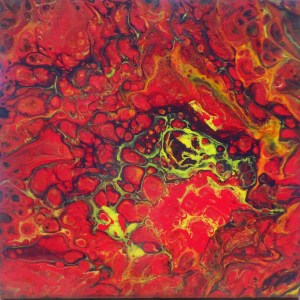
I have been trying Pour Painting, which – as the name suggests – involves pouring paint. But it’s a bit more complicated than that, as you might expect. You mix each color of paint with pouring medium, which was in turn mixed from three other ingredients. One of those ingredients is silicone oil, which helps the paint to make “cells,” or small bubbles of a different color. Here is an example of a pour painting with lots of cells:

“Rainbow Fire,” 24″ x 18.” See the red “cells” in the blue area?

The next step is to layer the colors in a larger cup. This is where you start making artistic decisions. What is your color palette? I found that I particularly liked the bold combination of black and metallic paints. You have to consider that adjacent colors may blend. With some color combinations, that could be a bonus; with others a disaster. Next you consider how you want to apply the paint to the canvas. With the painting below, I poured the paint across the canvas in a sort of S shape. The blending of colors here added a softness to the painting.

“Jupiter,” 18″ x 24″  You can still see that basic movement in the finished image.

In other instances, I turned the whole cup over onto the canvas and allowed the paint to flow over it. Here’s an example:

“By the Time I Got to Woodstock,” 12″ x 12″

Next comes the fun part. It’s a kind of collaboration between the artist and the medium. You tilt the canvas to move the paint. The paint, of course, has its own ideas about how to move. You make artistic decisions on the fly. Is there an area that doesn’t please you? Let it drip right off the edge. Is there a particular kind of movement you want? Tilt the canvas to encourage that.

Pour painting is not a small undertaking! I did it with my artist friend Cindy Griffith. We set up in her garage. First, we covered the floor with tarps and plastic. Then we brought in tables and covered those with plastic too. We set up a drying area using a ladder propped horizontally. We put newspaper (and usually cardboard as well) over the tables. On a central table, we laid out our paint and mixed many cups of colors with pouring medium. We wore old clothes and surgical gloves. We had a hose nearby to clean cups, other materials, and ourselves.

What a mess! You can see why we will only do it if we can set up with access to the outdoors and with plans to paint a few days in a row. It’s tiring, too. We were on our feet for hours every day. But what fun! Each painting is a surprise. Look at the “Pour Paintings” page to see all of them. But I will leave you with a final image here:

“Dragon Flight,” 18″ x 24″ Do you see that dragon? I did not plan that!

Posted in Uncategorized | 4 Comments

Green!

Summer paintings can be a challenge because they are so, well, green. First, although there may be a hundred shades of green, it’s still all green, and a single color lacks interest. Green is the bane of artists. Somehow, the green in that spot in the grass, in the tips of that tree’s branches, the green right in front of your eyes, is never in your selection of pastels.  Pablo Picasso famously said, “They’ll sell you thousands of greens. Veronese green and emerald green and cadmium green and any sort of green you like, but that particular green, never.” At this point, every artist reading this is nodding in agreement.

One solution is to mix greens, and often you can get just what you need that way. Why the manufacturers of pigments cannot also mix greens to get what I need is a mystery.

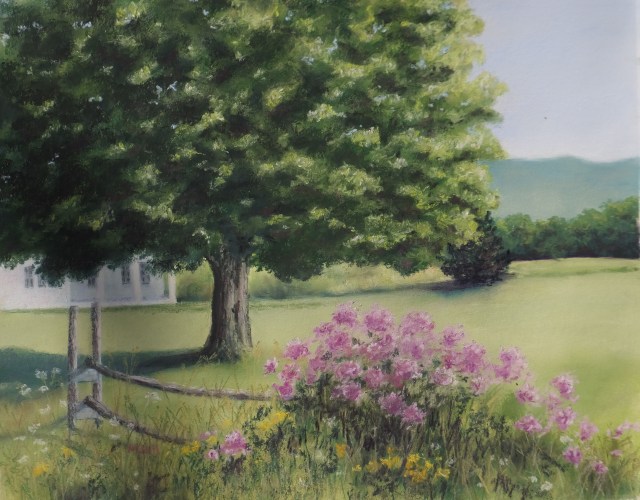
In “Midsummer Maple,” I was faced with a delightful abundance of greens. Sigh. I love them, but they are a challenge. Here’s the painting:


“Midsummer Maple,” 16 ” x 20″

This is a larger than usual image so that you can see some of the difficulties and my solutions. I cannot tell you how many efforts I made to get the color of the grass just right! Finally, I tried a fairly bright yellow-green (close to the patch of grass just to the right of the flowers), painted a very pale yellow – almost white – over it (Pastellists call it “scumbling”) and blended the two. Voila! Whew.

The tree is the star of this painting. I love all trees, and here in Vermont a maple is certainly nothing special, but I think they are my favorite. Look at this one, in its prime. It’s a rich explosion of a tree, a lush exuberance of a tree, the very definition of maple health. Oh, I wanted to paint that tree!

Most representational painting is a matter of using a two-dimensional format and making the subject look three-dimensional. For a tree, that means “sculpting” it with light so that you can see the shape not only of the tree itself but also of the branches. Every kind of tree has its own characteristic arrangement of branches, with those of the maple being fairly horizontal. See how the shadows in the left part of the tree, away from the light, gradually become less frequent as you look at the tree’s right side. Yet even in the side facing the light, there are shadows, and these define the branches.

Looking at the tree, it’s easy to think that it’s just green, with a lighter and darker green. But there are at least half a dozen greens in that tree’s leaves, and another three or four in the shadowed areas.

As to the overall green of the image, this has the visual relief of those magenta flowers as well as the half-hidden house and the distant mountains. The magenta of the flowers (again, there are four or five shades of it in there) is a direct opposite on the color wheel of yellow-green, so the viewer gets the excitement of that contrast.

I don’t know that you can see it in this image, but I also added magenta throughout the painting. A dark magenta is in the far trees. Both dark and pale magenta are in the maple, its leaves as well as the trunk. The fence and house are both touched with the color. It’s the kind of thing that most people won’t “see” (in the sense of being aware that it is there) when looking at the painting, but they will respond to it. And that’s what art is all about: the response of the viewer.

Posted in Uncategorized | 2 Comments

The Seasonality of Painting

One of the pleasures of painting is that I can immerse myself in any season at any time. Longing for green in winter? No problem! Feeling a need for the hot colors of autumn? Easy!

But in general, I find that I tend to paint the season that I am experiencing. Sometimes there’s a lag, especially with winter, as I slowly let go of fall’s fiery display, but eventually I come to rest in the reality that is outside my window. Here are my two most recent paintings:

“Yellow House,” 11″ x 14″. This scene is deep into winter, but it has a certain warmth to it nonetheless, because of the color of the house and even the snowy near hillside. I used an olive green paper, which has a bit of warmth to it. You can see the paper showing through in those background trees, since I used small choppy strokes of pastel and allowed the paper to show through to give it texture. I like the effect. The subtle golds in the far trees and the road contrast with that cool blue-gray sky. The sky speaks of coming cold. The home and its setting speak of coziness.

And just finished:

“Winter in Parentheses,” 12″ x 18″. On today’s weather report, the forecaster mentioned that this is the last day of winter’s historically coldest average temperatures, which start January 9th and slowly change as of January 30th. I must have felt that in my bones when I chose this image to paint. This is the depth of winter: the sweep of snow, the lowering clouds, the pale sun. But there is light here as well. The small structure is now in the distance, looking not cozy so much as protective. This is a portrait of winter’s power, and the force of the season is prominent. The paper underneath is black. It does not show anywhere, but I think it adds a depth and solidity to the scene.

I find it interesting that I usually paint the current season. Of course, I have much lived memory to bring to painting the images of any time of year. But there must be something about living it right now that helps to shape what I want to paint. Perhaps it is that every season, even the slushy mud of early spring’s “mud season” and the stark colors of late fall’s “stick season,” has its own visual message.

Posted in Uncategorized | 5 Comments

Abstracting the Landscape

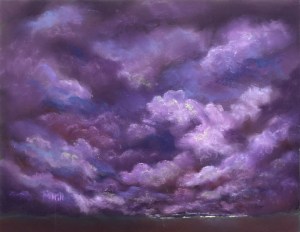
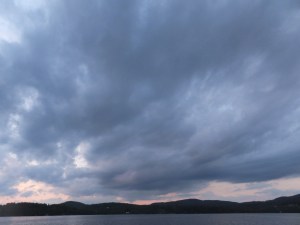
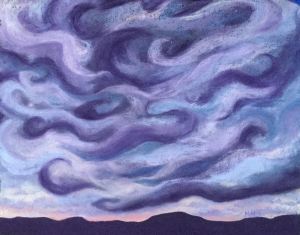
This was my starting point. What a dramatic sky! I especially loved the dark curve in the lowest part of the big cloud just over the horizon and toward the right. I painted a fairly accurate version, although I amped up the colors, making the clouds more violet and that hint of peach-pink over the hills more pronounced. It was lovely, but it just did not do it for me. I wondered why.

Look at the photo. The sky is full of movement! I wanted a painting with that kind of energy, that kind of spirit: a roiling, glorious cloud explosion. I started cautiously, accentuating and defining that lower part of the cloud even further. I found myself giving it a little curl on the left. I liked that! Why not, I thought? Why not just go for it, make the sky full of swirls?

Worst case, it would fail and I would throw it away. It wouldn’t be the first time. When I was first starting to paint, Jayne Shoup (check out her amazing art: http://www.jayneshoupstudio.com) invited me to her studio, showed me lots of particulars about materials, and answered my many questions. I remember her saying that when she finished a painting, she judged whether it was successful. If not, it went into the fire. That was certainly a freeing thought!

I started looking at the parts of the clouds as just shapes, then made those shapes more evident, adding curls to show the movement. I pressed on, until the painting was no longer an exaggerated realism, but something quite different: a sky full of activity. Finally, I thought, looking at what I had done: Here is the spirit of that sky! This is the result:

Posted in Uncategorized | Tagged , , , , , , , | 2 Comments

Awards!

As someone fairly new to art, it can be hard for me to get a real sense of where my work stands relative to others’. Visual art, like all the arts, is very subjective, although there is perhaps some general agreement about levels of quality. You know the difference between a Broadway play and a high school production, even an excellent high school production. But within those general categories, it comes down – at least largely – to the viewer.

I once submitted a painting to a juried show. It was declined. Soon after, I submitted it to another juried show, more prestigious than the first, where it was accepted and sold before the opening reception. I had a similar experience with writing some years ago. I submitted a manuscript to a professional journal, and they rejected it. The rejection letter was so vague that I had no guidance about how to revise it. So I submitted it untouched to another journal (and again, a more prestigious one), where it was accepted and used as the lead article in that issue of the journal. Go figure.

For the last few years, I have been been bringing paintings to the Champlain Valley Fair here in Vermont. The art show attracts a large number of artists, from beginners to professionals. I fall somewhere in the vast in-between. And I have won awards there! It’s only the Fair, but it is so gratifying to know that someone (they do use judges who are well-known artists or gallery owners) finds my work worth a ribbon. And this year, for the first time, I won first place in pastels! I am so psyched about this! Here is the winning painting (“Why I Live Here,” 18″ x 24″):

And here, for your perusal, are paintings that have won awards in prior years:

“Afternoon Enchantment,” 16″ x 20,” second place:


“Gateway,” 14″ x 11,” second place:


“Cool River Depths,” 9″ x 12,” third place:


“My Neighbor’s Barn,” 16″ x 20,” honorable mention:


“River of Corn,” 9″ x 12,” honorable mention:

And there they are:  The prize winners! Don’t you wish adults got prizes more regularly?

Posted in Uncategorized | Tagged , , , , , , , , | 3 Comments

Sometimes Art Fights Back!

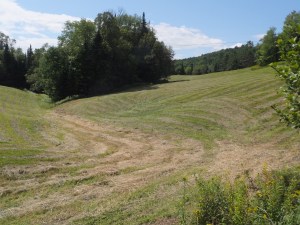
Last summer I took photos of a local pasture:

With the photos right next to one another, you can see that it’s two sides of the same pasture. That large clump of trees at the right of the left hand photo (that’s cut off by the edge of the image) is the same seen in its entirety in the center left of the right-hand photo. I took the photos a few days apart, and you can also see that the field has been hayed in the meantime.

I really loved the sculptural aspects of this landscape: the curving shape of the land, the sinuous lines of the grasses. Those lines are especially obvious in the image of the hayed field on the right, but you can see them in the left image as well. See the slightly bluer band of grasses snaking down from the tree clump to the foreground? The slanting lines of the brighter yellow-green coming from the left side?

I wanted to emphasize all that movement, and color seemed a good way to do it. Green-on-green is subtle. I was not interested in subtle!

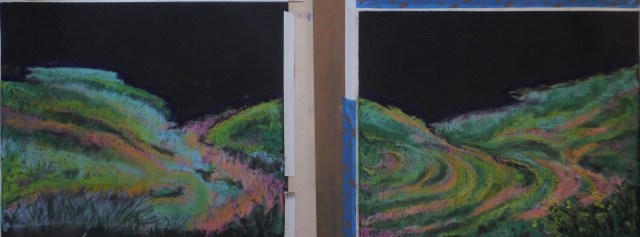
I used black paper, wanting to let some of the black to give texture and depth to the grasses. I set up side-by-side easels so that I could work on both paintings at once. I thought that might make it easier to be sure the paintings were connected. I imagined two paintings that could each stand alone, but that would also work beautifully together. I worked on the lines of the pastures first, since they seemed the most important part of the paintings, and I wanted to get them right. But they were not right. The colors seemed a bit off to me, and the whole thing seemed too stripey. Ugh. Here is that stage:

Can these paintings be saved? Not as they were! I washed out the whole thing. Art Spectrum paper will take washing, at least up to a point. I might have overdone it! You retain a ghostly image, but that’s just fine if you are doing the same painting. I tried again. But the washing had damaged the paper a bit and the ghost image meant that I lost the texture that I wanted from the black paper. I overworked it in my efforts to get something I liked. I threw them both out.

Sometimes you have to admit defeat.

But the idea continued to call to me. I really wanted to make those paintings. After a break of a month or two, I tried again, this time doing one painting at a time, hoping that it would feel less daunting that way. Sometimes when I am stuck with a painting, I think my creative mind works on it while I am going about my life. Occasionally I have dreams offering solutions. Often, I just leave the painting up on the easel and look at it once in a while until the solution seems clear. But in this case I guess it was the passage of time and whatever mysterious thing happens in some subterranean way. It also helped that I tackled it during my painting retreat with my friend Cindy, so I could get moral and artistic support!

It worked. I finished the first painting, tackled the second, and was happy with both. Hooray! At long last! Here they are:


I love them! It’s exactly what I wanted. They are clearly twinned, but each is complete in itself. The colors are similar, but the balance of the colors are somewhat different in each. They have that texture of the black paper. They have movement, lots of movement. One thing I did was to remove the foreground grasses in the photos, which I realized were just a distraction. I omitted the pinks, which I liked but which complicated the palette too much. But mostly I gave it time. And mostly I didn’t give up.

Posted in Uncategorized | Tagged , , , , , , , , , , | 5 Comments

A Painting Retreat

I spent six days, more or less all day, painting with friend and fellow artist Cindy Griffith. It was demanding! It’s great to have company for something like this, not only for the critique (although that helps enormously) but also for the company. Who knows if I would have stuck it out otherwise? I think it would have been too easy to decide that I really needed to get some laundry done, or run into town, or (truth be told) just goof off.

I started with the unfinished painting already up on my easel.

  “Pastoral,” 11″ 14″. I did an underpainting in oranges and reds, which peek though here and there, adding a little liveliness to an otherwise quiet scene. The focus is on those beautiful clouds (which I enhanced, naturally!) and the relationship between the land and the road and attached path, with the barn something you notice later.

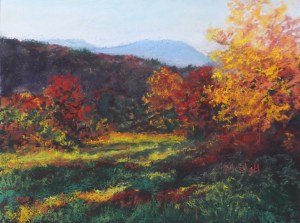
  “Golden,” 9″x 12″. After all that quiet, I wanted intense color, and this as it. In the late afternoon light, autumn colors glow. The task here was to create enough muted areas (the further hills and the shaded foreground) to make the bright areas pop. I like the result.

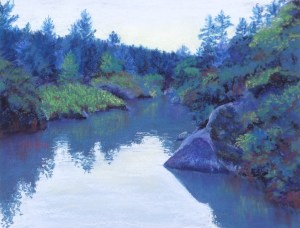
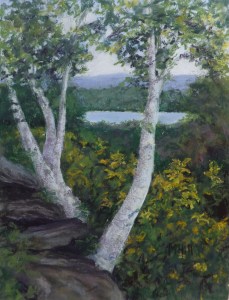
  “Lake Country Birches,” 12″ x 9″. Then I went to a scene from recent visit with my cousin. I’d brought a number of reference photos with me for this retreat.  Choosing one to work from is an interesting thing: what appeals to me one day might fall flat when I look at it another time. Rocks, birches, goldenrod, lake, and distant hills. I love the layering here, bringing the eye from what is right in front of you into the distance.

I’d warmed up enough, I decided. I took a deep breath and pulled out the photos for two paired paintings that had been eluding me. I’d worked on them twice before, and both times had been dissatisfied and thrown them out. As you can imagine, I was a little apprehensive about trying again! But this time they worked. I guess I learned something from those four failures. Here they are:


These are “Pasture Rhythm 1” and “Pasture Rhythm 2,” each 16″ x 20″. They are two sides of the same field, and I very much wanted to make twinned paintings that both stood alone and were clearly connected to one another. It occurs to me that this is a great metaphor for a good relationship! I am very happy indeed with the result. I used black paper and a light touch in the foreground to indicate texture.

After that challenge, I felt that I needed a little respite, and pulled out two mostly finished paintings that just did not quite work. In both cases, I liked the start that I had made, but could not figure out what was needed to make the paintings come togther. It’s amazing what ignoring a painting for a few months can do for your understanding of it! In both cases, I figure out what changes I needed to make without too much trouble. Here they are.

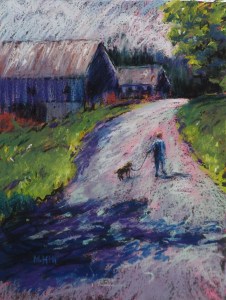
  “Judy and Lily, 12″ x 9”. This is a departure from my usual style. I was experimenting with making looser, more energetic marks and not blending. This does not mean that it was easy, however! I have two or three other versions of this that did not work at all.

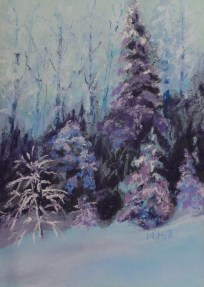
  “Laden,” 7″ x 5″. Heavy snow and the cool blues and purples of winter. This little scene is right outside my window.

And next…..

  “Sky Song,” 9″ x 12″. I invented the swoop of the sky here, although the rest of the scene is pretty faithful to the actuality. I like the solid, still quality of the November earth contrasted with the uplift of the sky.

Apparently I had transitioned into the realm of spirit in my painting at this point in the retreat. I was drawn to another photo of sky, and decided that I wanted to change the cloud shapes so that they suggested wings. Here is my final painting from the retreat.

  “Winged,” 11″x 14″.

May these paintings feed your spirit as much as making them did mine.


Posted in Uncategorized | Tagged , , , , , , , , | 7 Comments

Vermont Autumn

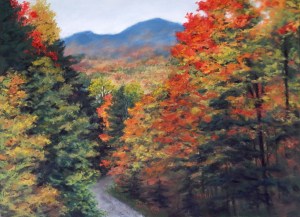
The leaves have turned and all is glorious. On the back roads the air smells vaguely of apples: wild apple trees are common, and the dropped apples feed deer, bears, and others. Here, for your enjoyment, are some of my more recent fall paintings.

  “Stowe Autumn”


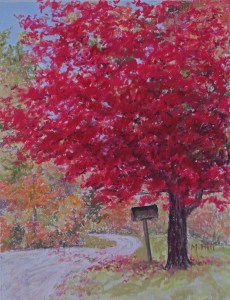
   “Scarlet”


   “Fall Layers”


   “At the Mountain’s Feet”


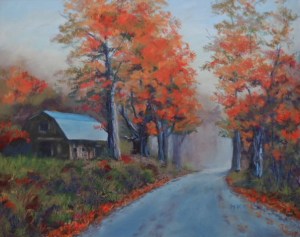
   “My Neighbor’s Barn”

A little visual gift from Vermont! Enjoy the season.


Posted in Uncategorized | 3 Comments

Going BOLD!

I love powerful colors: they can make you look at a landscape in an entirely new way. The last three paintings I’ve made reflect this. Here they are. I’ve included the reference photos that I worked from, because it’s worth seeing the liberties that I took with color and other elements, especially rhythm and movement.

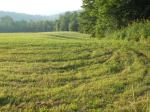
Here is the first reference photo. I liked the sweep of the field, with those tractor ruts, moving your eye around to the distant trees.

And the completed painting: “In Green Pastures,” 12″ x 16″. See how I exaggerated the swirls of the field? I added foreground elements so that the scene did not just “fall off” the bottom of the page. And of course I amped up the color and the curves of the hills. This is the feeling of the scene, at least to me, if not the literal actuality!

Here is the next reference photo. This is Caspian Lake, in Greensboro, VT. I responded to the layering here: the foreground goldenrod, the curve of fields with trees, the lake with the hills in the distance.

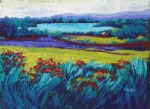
And the result! “Yin-Yang Landscape,” 12″ x 16″. The title refers to the contrast between the quiet of the lake and the fiery movement and color in the foreground. Yes, the elements are all there, but would you even recognize this scene? The colors are not only exaggerated, they are changed; the fields now include purple and dark red. I made the foreground shades of turquoise to harmonize with the color of the lake. And the goldenrod became some dark red flowers from my imagination, the better to contrast with that bright green field. I repeated colors: the red in the field and the flowers, the turquoise in the lake and foreground, and the purple in the distance as well as in the field’s shadow and the foreground. I am very pleased with the result!

And the final reference photo. It’s washed out, but you can get a sense of the image: a driveway leading to the lake (this is also Caspian Lake) and a home in the distance among the trees. The grasses appealed to me here, as well as the slightly mysterious quality of the road and the partially-hidden house. Here’s the painting:

This is “Headed to Camp,” 11″ x 14″. Now the focus is almost entirely on that camp road, the grasses, and the shining destination of the lake. The house is barely visible. I used a limited palette of magentas, light turquoise, greens, and a touch of gold. I do love the effect of those colors on the grass. I “moved” trees and bushes to frame the scene. And, hey, I can make a light magenta sky if I want to!

With all of these paintings, I used a similar technique. They are done on black paper, which I have allowed to show through for texture (for example, in the camp road) or for rich darks (in all three of the paintings). I often exaggerate color and movement, but I have carried that further than usual in these paintings. I spent a lot of time thinking about how I wanted to proceed and about colors, although as with any painting, the painting itself starts to make demands after a while. And I worked slowly, considering almost every stroke. Since I wanted to make use of the black paper, I couldn’t just cover it up. I am very happy indeed with the results.

So for your next painting, go BOLD!


Posted in Uncategorized | Tagged , , , , , , , , , , | 2 Comments

Painting Conversations

This is a dual-meaning title! I’m referring to my latest painting, “Sky and Lake Conversation,” as well as the process of painting it. Here’s what I mean…..

My painting started with this reference photo.

Lovely, isn’t it? I have been drawn to (ha, ha: art joke) these complex skies lately. They are so evocative. Of course, they are also difficult, and when I am painting I am complaining to myself about wanting to paint such complicated clouds. In the painting, I lowered the horizon to further emphasize the sky and added darker colors, even a dark red, to further dramatize the clouds. I painted the clouds with more variation in dark and light than the photo as well.  I saturated the colors somewhat, painting richer blues and exaggerating the salmon colors. I lightened the glow of the unclouded sky, since that was much of what appealed to me in the scene. Here is the initial version of the painting.


At this point in any painting, at least for me, it is time to ignore the reference photo. The photo starts me off and reminds me of the basic shapes and colors, as well as the feeling, of what I want to convey. But once I have that down, there is a conversation between the artist and the painting. This painting still looked too simple to me. It lacked something. The non-cloudy areas of sky somehow seemed too empty. I added more soft colors to the open sky areas. This meant that the lake reflections also needed to be altered. I also slow down at this stage of painting, making a small change and checking the effect before making another. I included very dark greens in the low hills, to soften the almost-black quality there.  I added the tiniest touch of an almost neon orange in the “sweet spot” of the orange glow above the center right hills. Some of the clouds seemed too dark, so I changed that. I went back and forth, sky and lake, air and water. This is the final painting.
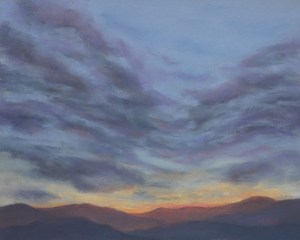
Next comes the matter of the title. What am I saying with this painting? It’s about the relationship between the sky and the water, just as it was when I painted it. So I am calling it “Sky and Lake Conversation.”


Posted in Uncategorized | Tagged , , , , , , , , , | 5 Comments