A Change of Medium

I have been very clear about wanting to stick with pastels as my medium since I started painting about six years ago. I am relatively new to art and felt that there was so much to learn about pastels that I did not want to muddy the waters with another medium. But this past fall I was looking at the Community College catalog and saw a watercolor painting class. “Why not?” I thought. When you are 65 or better you can take any class in the state college and university system for free, meaning just the registration fee. I signed right up!

It was a great experience. The teacher was encouraging and knowledgeable, the other students diverse and enjoyable. I struggled with the medium, especially at first. It’s not very forgiving: you cannot erase or layer over any mistakes very readily. You can do both with pastel and no one’s the wiser. It took some practice to begin to get the drift of how much water to use. And it does not necessarily stay where you put it!

That latter quality, however, can be a strength of the medium, and I discovered that it makes beautiful skies, water, and snow: all things that are not very defined and that benefit from the loose transitions from color to color that is easy with this medium. It can have a particularly luminous quality, because of the transparent nature of the pigment. I liked that quite a bit. I can see that I have a long way to go before I develop any real expertise, even the level of expertise that I have with pastel. But I at least got friendlier with the medium and am happy with some of what I produced. Here are a few examples:

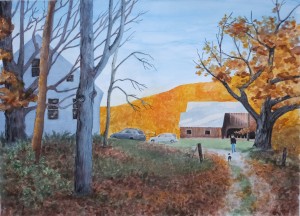
Jamie's House

“Jamie’s House” This is a large painting (about 21″ x 29″) and certainly took a lot of time. With watercolor, you have to plan out carefully how you will approach the painting, because once it’s down, it’s down for good. I worked more or less from back to front, with sky first, then the distant hill, then the house and barn, the foreground grass and leaves, trees, then finally the cars, the person and the dog. You can use masking fluid to cover things that you want to keep paint off, and that was necessary for the tree branches and some of the details. The painting sold right away, hooray!

watercolor 1

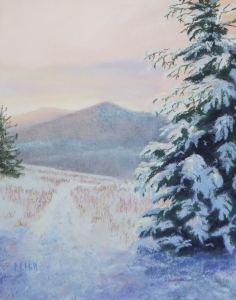
Here is a watercolor version of the pastel painting “Gentle Evening.” (9″ x 12″) You can see the lighter quality of the image compared to the pastel.

And finally, perhaps my favorite…..

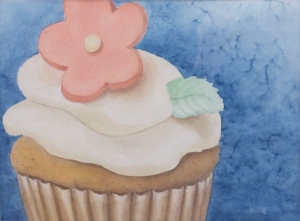
Cupcake!

“Cupcake!” 9″ x 12″. We did still lifes in class, which of course are terrific exercises, but I do loathe them. I rarely like them as paintings. They just seem like a collection of dead objects to me. So I asked if I could bring in something, and this is the result. It was not easy….well, I guess none of these paintings were easy, given that I did not know what I was doing. But it was fun, because I liked the subject. And when I was done painting it, I ATE the subject! I actually framed this one and have it for sale on my “Town Scenes, Flowers, and Food” page. I may well frame the prior painting too.

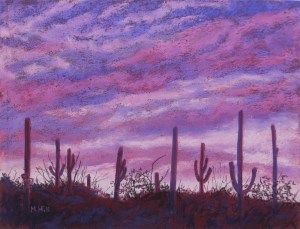
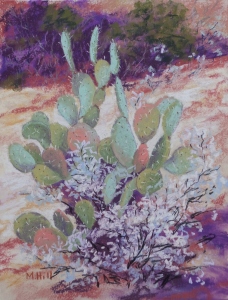
I am off to Tucson in a couple of weeks and will be there a month. This is an experiment in shortening winter. I have various friends joining me throughout that time. I will be painting the Sonoran desert, which is a landscape that I particularly love. I will report when I get back!


Posted in Uncategorized | Tagged , , , , , , | 2 Comments

Two Sister Paintings

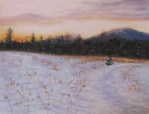
I don’t mean that these are paintings of sisters, though! They are from photos taken during the same late afternoon winter walk, and you can clearly see the “family resemblance.”

Dusk Comes Early “Dusk Comes Early,” 9″ x 12″

I was drawn to the softness of this scene. The gold of the dried grasses poking up through the snow echoes the gold in the sunset. The path is only subtly visible, mostly because there are no grasses there, and I like the small evergreen that stands like a little sentinel to one edge. The glow of the sky limns the edge of the mountains with light.

DSCF1323 “Gentle Evening,” 10″ x 8″

I must have taken this photo slightly before the prior one, because the colors of the sky are just starting to show in pale pastels. The mountains have even more light on them, a wash of pink and gold. I like the intimacy of this scene: it feels to me that I am standing right behind that tree, looking at the mountain beyond. I let both trees here go off the page, to better draw the viewer into the scene. And again here are those gold grasses.

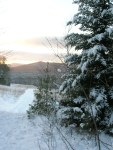
In both scenes, I used my artistic license to increase the colors. Winter, even at sunset, can be so monochrome. I exaggerated the colors in the sky and added them to the snow, even the snow on the tree branches. Here is the reference photo for “Gentle Evening,” so you can see the changes.

003 (2)

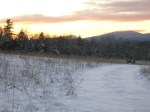
And the reference photo for “Dusk Comes Early”:

008

Here I had a somewhat different challenge. The colors in the sky are lovely, but because it is later in the day, the foreground is quite dull and the mountains and trees almost in silhouette. The grasses are too prominent, adding a distracting messiness. All of these things can be changed, and I did!

If you compare the photos to the paintings, you will see that I made both scenes much warmer than they were in actuality. They have pinks and yellows that were perhaps barely suggested in the photos, but are clearly present in the paintings. My goal, as always, is not to show reality. You can see reality for yourself. My goal is to show something of the spirit of the place, something more of truth than reality. I hope that both of these paintings do just that.

Posted in Uncategorized | Tagged , , , , , , , | Leave a comment

A Painting Intensive

This past week I did a four day painting retreat with another artist. We set up in my home, painted from 9:00 am to 4:00 pm, then just left our stuff there for the next day. I had anticipated becoming exhausted and overwhelmed by this: painting is very demanding. Usually I can paint for perhaps three hours at a stretch and then need to stop. I had even purchased a big bag of peanut m & m, guessing that there would come a time when we had to lie on the couch and eat them before we could manage to paint again!

But in fact it was fine, and I even wished that we could have extended it for another two or three days. Amazing. Some of that was the company of another artist, someone with whom to consult (“does this look right?”) and complain (“this is hard! this isn’t working!”). Although I think that much of what is helpful about painting with another artist is just to be in the room with another person who is engaged in a similar process and struggle.

I made a number of new paintings, and I like all of them. Three are pastels; here they are:

Softly, Softly This is “Softly, Softly,” a portrait of a particular dawn. I was so attracted to the soft pinkish sky and mist, with the silhouette of the trees and bushes.

Winter Brilliance “Winter Brilliance,” a painting of just that: one of those sharply clear winter days when both sky and snow glow with light.

Gateway And finally, “Gateway.” I thought of the name of this painting when I took the photograph for it, as occasionally happens. The trees framing the morning looked like a door to me, opening into the day. I love the image and the concept.

My painting companion sometimes works in acrylics and brought her acrylic painting materials for me to try. It was so interesting to use a completely different medium! It handles very differently from pastel, of course. Perhaps it was a matter of my unfamiliarity with the medium, or the distance provided by using a brush instead of my hands, but I found myself making somewhat more abstract and bolder images. Here is the first:

Holding the Sky I named this “Holding the Sky.” I put the tree in first, using an image of a local tree for reference. Then I put in the sky, or what I suppose passes for sky. It certainly is not like a “real” sky! As I painted the sky around the branches, the daubs of paint went over them in places, creating a sort of jagged effect. While I had assumed that I would re-establish the branches, I found that I liked that rough quality very much and mostly left it.

The next painting was the result of one of those inexplicable artistic impulses that one gets. I almost always paint landscapes, but I suddenly decided that I wanted to paint the aurora borealis. I guess that’s a landscape of sorts. Here it is: light in the sky mirrored by the water below.

Between Heaven and Earth This image in particular is a departure for me, but I do like the mysterious quality, just as the aurora itself has a mysterious quality.

All in all, a successful four days, I would say! I will definitely try it again. It was not easy to protect my time, even for only four days. I may be retired, but it is amazing how many claims there are on my time, things that need to be scheduled or time-sensitive things that need to be done. But it can be done, and is certainly worth it. I learned that I have more creative stamina than I thought I did. I learned that I like acrylics and that while they will have a certain materials-based learning curve, an artist is an artist and brings that sensibility and knowledge set to any medium. I learned that I can put my life on “pause,” more or less, for a few days and immerse myself in the flow, the demands, the struggles, the satisfactions, and the occasional gifts of creativity.


Posted in Uncategorized | 3 Comments

Autumn in Vermont

DSCF0894

Here is my most recent painting, “Fall Fishermen,” 9″ x 12″. I took the photo last year; we had a remarkable foliage season, with very bright colors that lingered longer than usual. This year is shaping up a bit differently. We had a few days of wind just as the leaves started turning, which means that we lost some of them. And we are not quite at peak color – at least not here in Central Vermont – which means that the season is unusually late for us.

I have exaggerated the colors of the foliage in the painting, but not by much. I enjoyed the symmetry of the reflections in the water. Interestingly, on a still day such as this, reflections can be very detailed, almost mirror-like. But if you paint it that way, it looks false. Instead, I blurred the shapes just a bit and darkened and muted the colors – again, just a bit.

Art is odd that way. To paint well, you need to learn to see, meaning to really observe color and shape and the reality of what is in front of you rather than your mind’s representation. Most people who say that they cannot draw really are saying that they have not learned to see; they are drawing some internal template of a tree, for example, rather than the unique (and usually flawed) tree in front of them. On the other hand, if you paint exactly what you see, it sometimes looks artificial, as with the reflections on the pond. Also, in most cases, reality is better represented with at least slight exaggerations to color or light.

Fall foliage in Vermont gives the impression of fire, of a wash of hot colors. Yet, if you look at any specific scene, even at the peak of a great year’s foliage, in fact many of the trees are a little muted, or still somewhat green. It’s the task of the artist to show the viewer what foliage looks and feels like, not the photographic truth. Or perhaps it is more accurate to say that it is the task of this artist to do so!

Posted in Uncategorized | Tagged , , , , , , | 4 Comments

Pushing Color (#2)

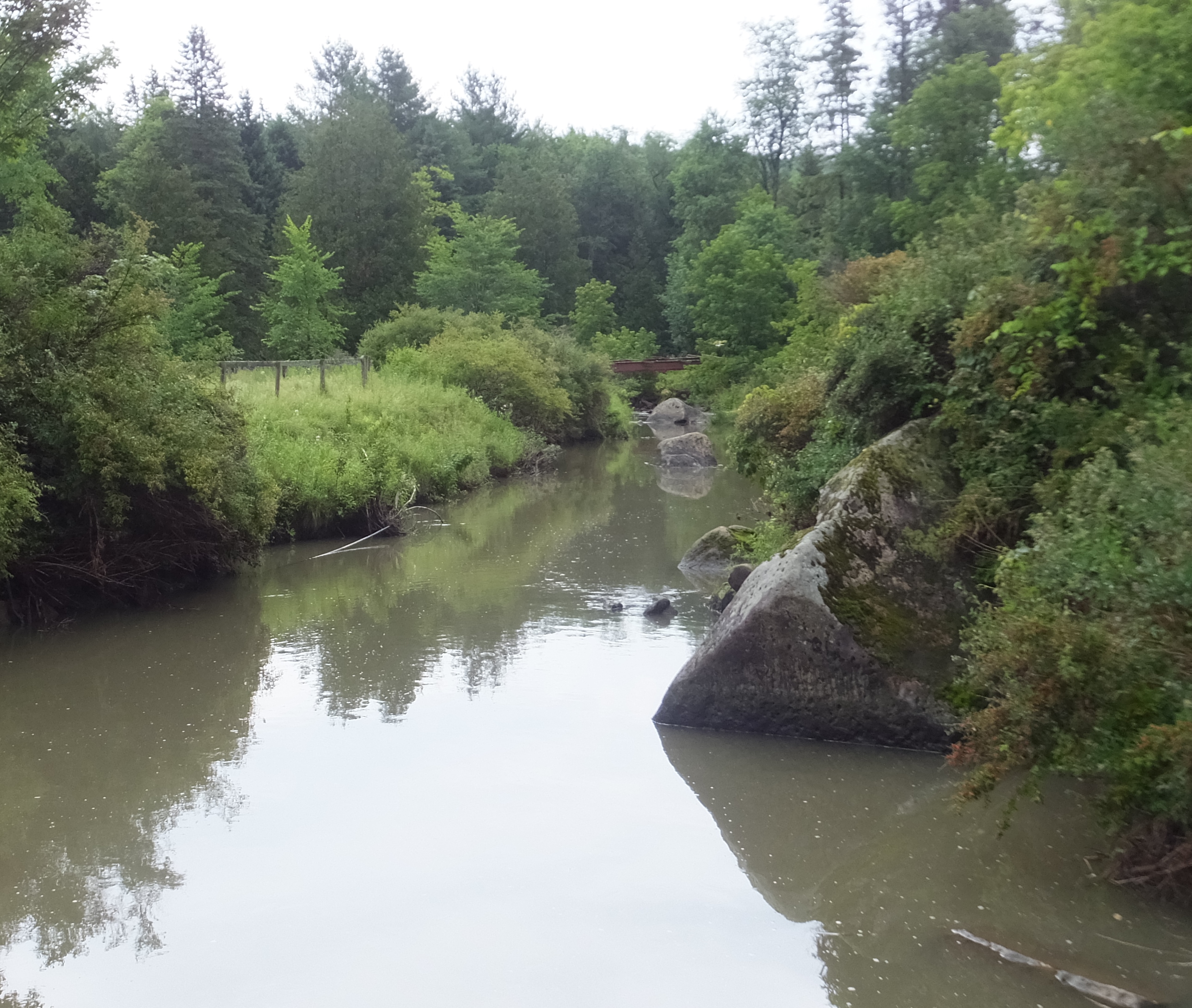
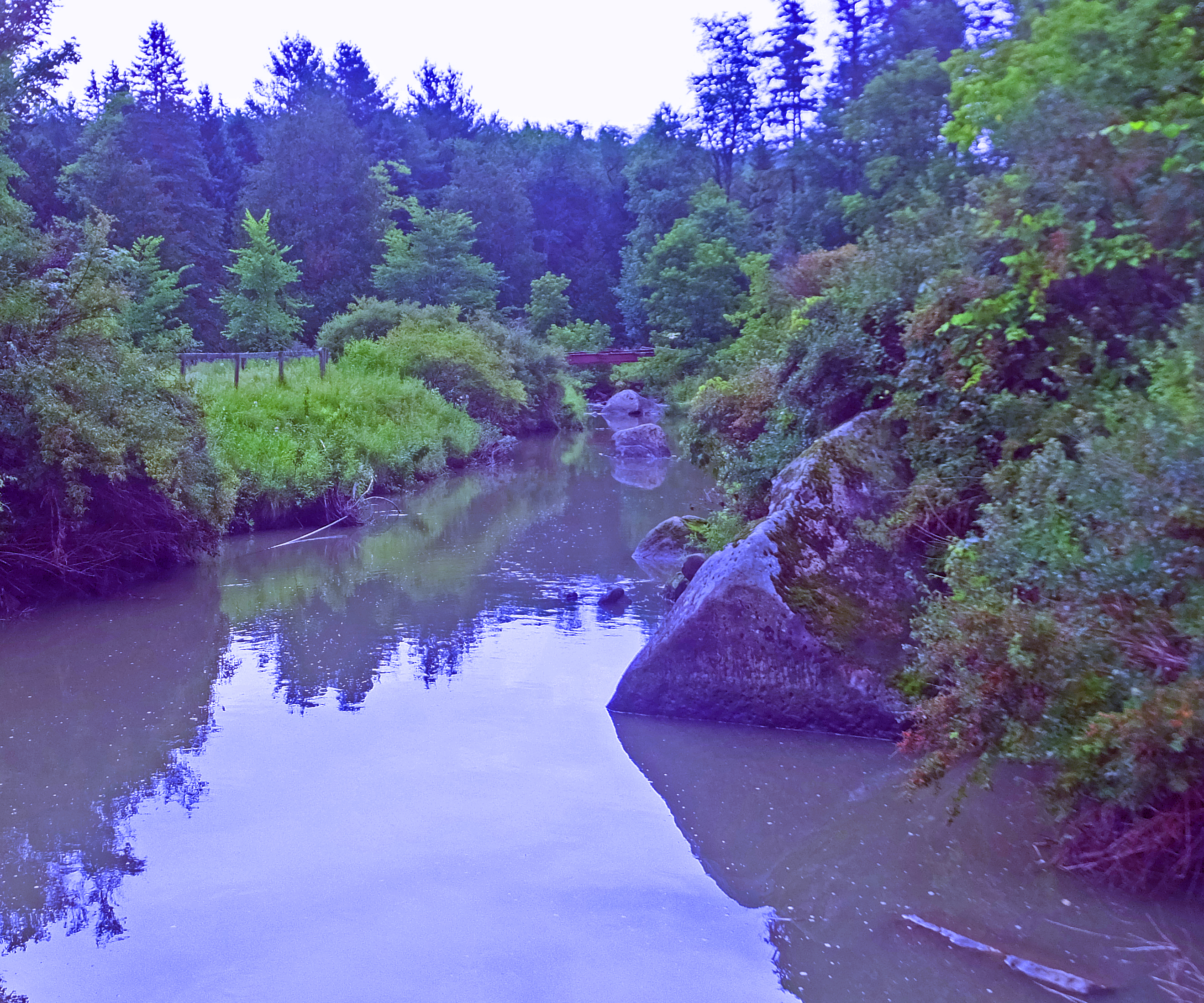
I change color in a variety of ways so I can better express the feeling of a place, but there are a couple of recent paintings (see prior blog) in which I pushed color primarily in one direction. The last painting was a push toward red; with this painting, I went toward blue. Here’s the reference photo:

002 (2)

This is the Black River, in Craftsbury, VT. I was delivering art to the Art House up there and mentioned that I was taking reference photos. The woman working there suggested I go look at the river right behind the building and this is the scene. Thank you, Ceilidh!

The composition is great, I think, with that wonderful triangular rock cutting into the bright reflection in the water and the angle of the river as it disappears into the distance. But to my mind, the colors add nothing in particular to the scene. The softness of the colors is appealing, but I wanted a way to express the depth and distance of the river’s path, the quality of something almost like secrecy as the river slides out of sight. I fooled around with possibilities, and this is what I liked best:

002 (3)

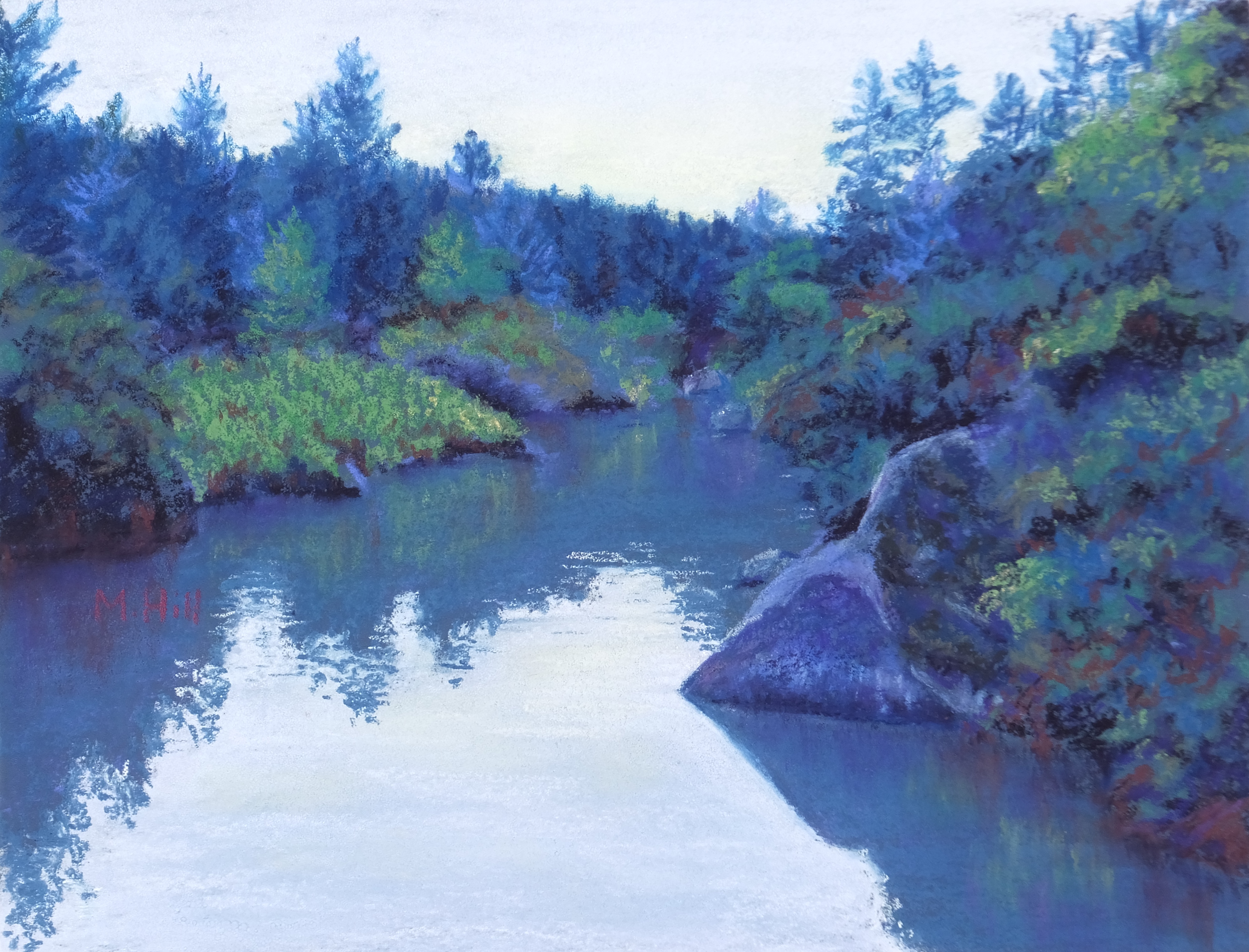
Mmmmm, look at those blues! They add a coolness to the scene and exactly the mysterious quality that I wanted. Here is the painting itself:

204

I preserved the softness of the original scene, especially in the reflections in the water. Interestingly, I have discovered that while reflections can appear quite sharp in actuality, they look artificial if you paint them that way. The entire painting is much more blue, not unlike the second (altered) photo. However, it still look real, almost as if it could have truly been these colors. This is because I have kept the relationships among the colors accurate, including relative darkness and lightness as well as the variations in blue and green. The one thing I did change was the lightness of the sky and the sky’s reflection in the water. Those I made brighter than my altered photo, wanting to emphasize the mirror of the water, which after all, was much of what attracted me to the scene.

And there it is, from original photo to concept to painting. To my mind, the most important part of painting is not the faithful rendition of what you see (although I greatly admire artists who do this!), but the addition of feeling, of something to convey the spirit of the landscape. I titled this painting “Cool River Depths,” and I hope it conveys just that.

Posted in Uncategorized | Tagged , , , , , , , , , | 2 Comments

Pushing Color (#1)

I have two new paintings. In both, I pushed color as a means of expression, and I like the results very much. To keep this blog to a reasonable length, I’ll describe them one at a time in two blog installments. Hey, you have something to look forward to!

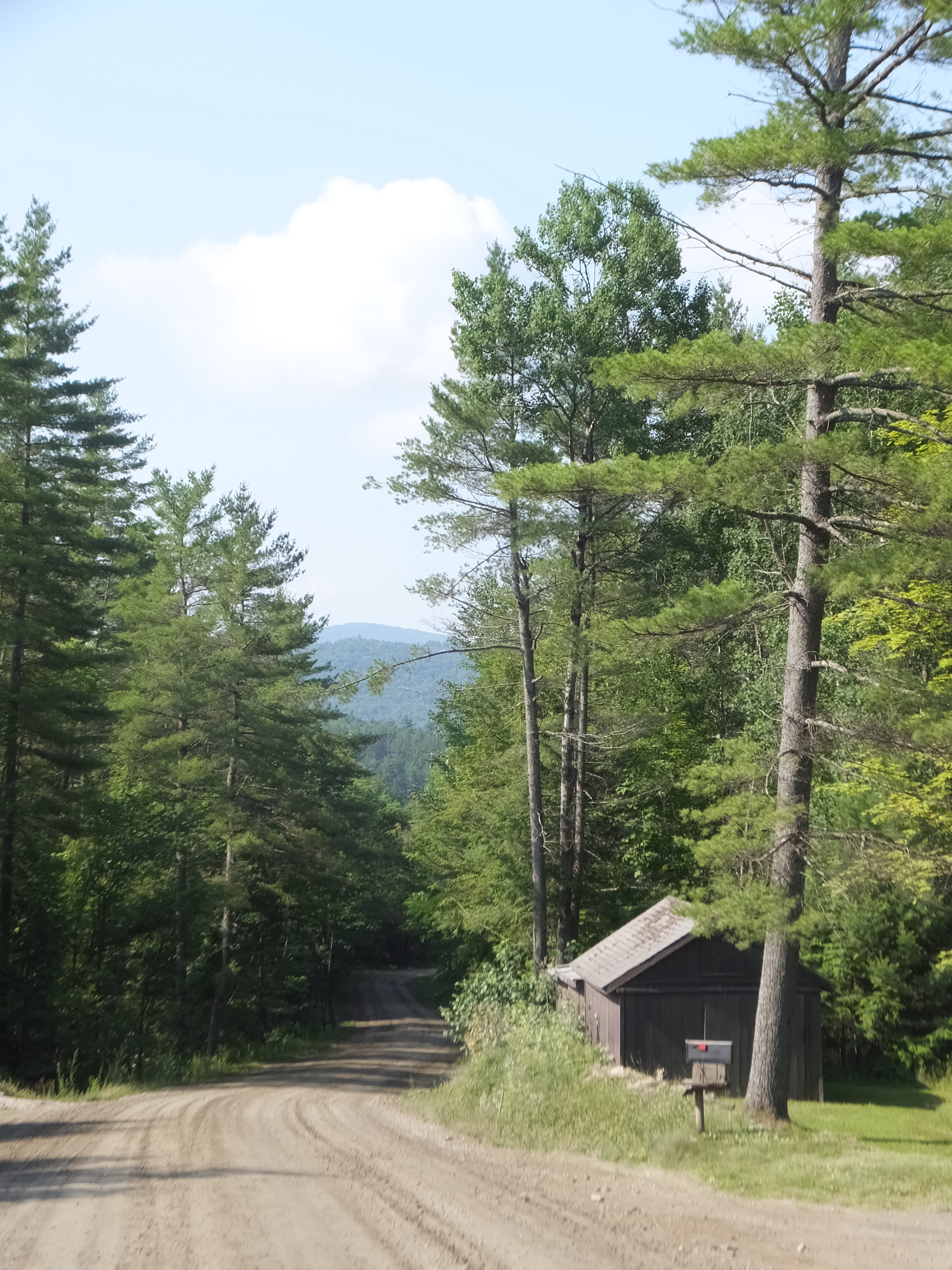
The first painting is “Along the Way,” an 18″ x 12.” First, look at the reference photo:

016

This is a fairly ordinary scene, but I liked the way the trees towered over that small shed. And the contrast between the sinuous curves of the road and the linearity of the pines appealed to me. But I felt that it needed some punch. So using the wonders of the computer, I distorted the entire scene toward red. Here is the result:

016 (2)

Now, that was interesting! I didn’t want to make a painting that was entirely red-orange, though. Then I considered that red and green are opposites on the color wheel, making for great visual contrast. I decided to keep the green of the tree leaves and pine needles — as well as the natural color of the sky — and go ahead with the red distortion everywhere else. Here is the painting:

196

I made the red much softer, but it is still most definitely there, even in the far mountains. The red makes the tree trunks stand out from the pine needles, which creates much more emphasis on that linearity. And I think the red – green combination makes for a far more rich and compelling painting than if I had stuck with “reality.” It has a somewhat Western feel, although the scene is right here in Middlesex, VT.

“Reality is overrated,” the saying goes, and when it comes to art, I generally agree. I admire realistic paintings, but I don’t want to make them myself. I want my art to say something more than the actual scene. I think this painting does just that.

Posted in Uncategorized | Tagged , , , , , , , , , | 3 Comments

A Painting Challenge

018

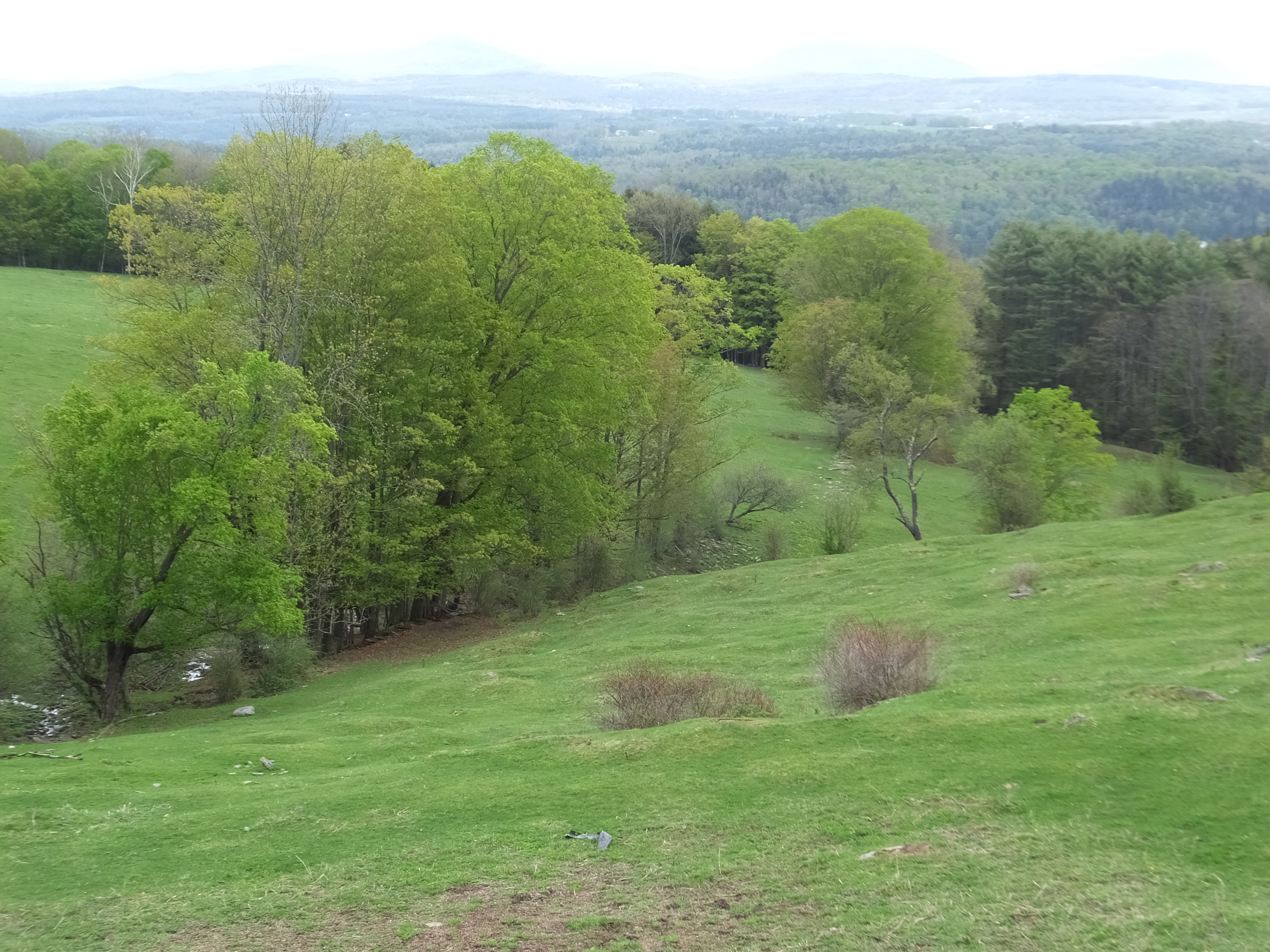
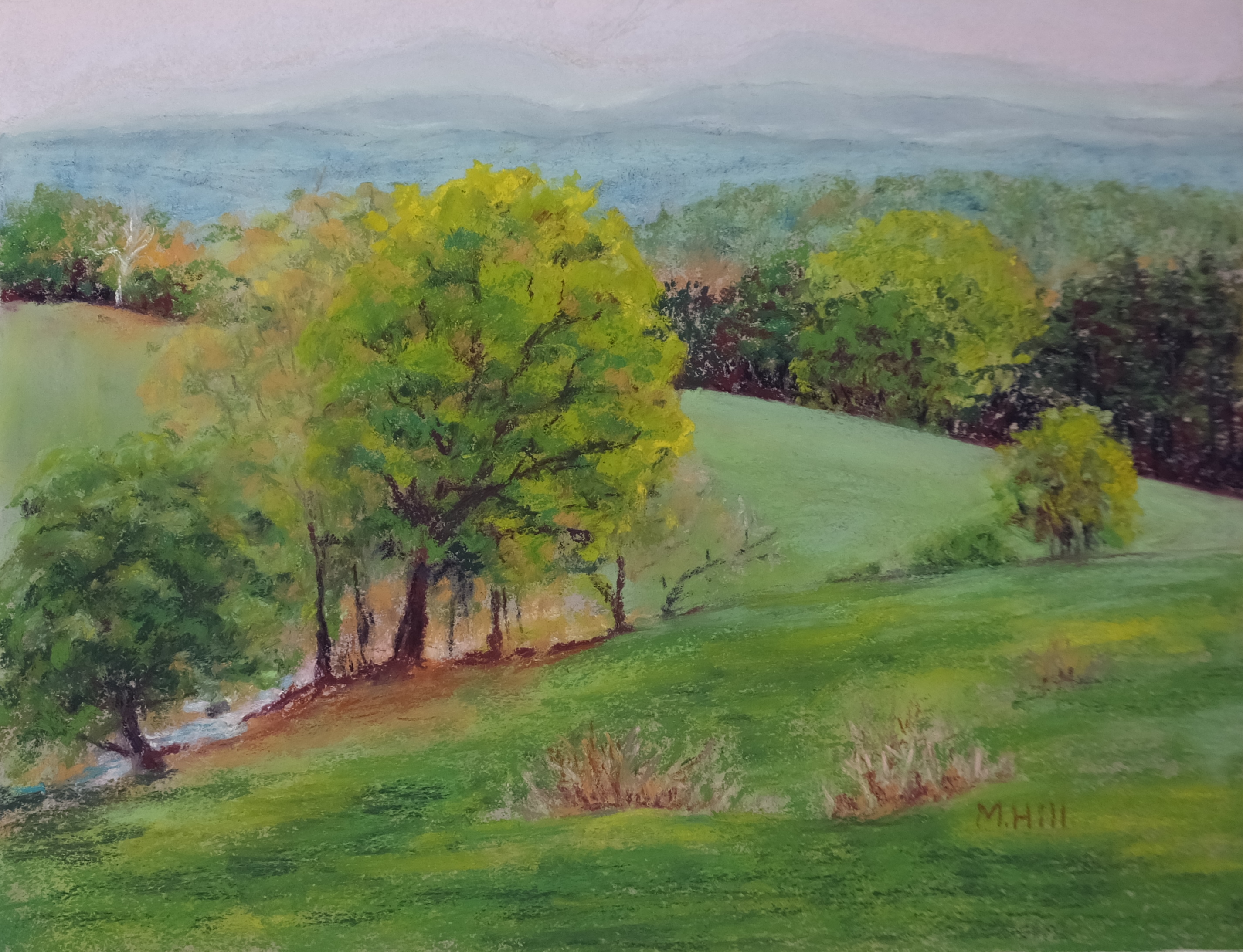
I took this photo this past May. Doesn’t it just sing of Spring? Robert Frost says, “Nature’s first green is gold/ Her hardest hue to hold.” That delicate spring green only lasts about three weeks and is gone, transformed into summer’s darker and sturdier greens. This scene has that lovely spring green in both the grass and the trees, and I very much wanted to paint it. But when I sat down to do so, I realized that it was not going to be easy.

The composition of the photo was great: see the way the lines of the hills lead your eye back and forth diagonally through the scene? So that part needed no adjustment. And the way that the far hills faded softly into the sky also was lovely just the way it was.

But there were two challenges, and they were significant ones. First, most of the scene is the same color! Yes, you can see slight differences in the greens, but they are indeed slight. The darker parts of the grass and the lighter parts of the near trees are almost the same color. And even the darker parts of the trees are not so much darker. And, for that matter, the near trees are very close in color to one another. Now, I did not want to change that too much, because all that juicy green was exactly what attracted me to the scene in the first place. But I was going to have to create more variations or I would end up with a painting that looked too uniform.

And, speaking of too uniform, the second challenge is that most of the painting is the same or similar value! “Value” is an art term referring to how light or dark something is. Changes in value are critical to making a painting interesting. In fact, I read somewhere – or perhaps heard it at a workshop – that “value does the work and color gets the glory.” That means we notice color but it’s the variations in light and dark that really are responsible for drama and interest. Yes, that scene has darker trees in the background and a darker line under the near trees. But the near trees and grass are very close in value. It was an overcast day when I took the photo, so there were no shadows or bright areas. I was going to have to invent value changes!

001 (3)

Here is my solution. I made a number of changes in the colors, without, as best I could, deviating too much from the yellow-greens of spring. The two hills are different greens, with the nearer hill being more yellow and varied in color. I’ve varied the greens in the near trees, too, making the largest tree quite yellow-green, two smaller (and further away) trees also yellow-green, but a softer version, and that smaller nearest tree a light green but not as yellow. I’ve also found excuses to add soft ochres and orange-browns and even pinks here and there. They were indeed in the photo, but much, much more muted.

And you can see how I emphasized and even invented greater value changes than those in the photo. I’ve kind of “pruned” the lower branches of the near trees to emphasize the dark trunks and branches. I’ve exaggerated that little trickle of bright water in the lower left. And I’ve lightened the back grassy hill to make it a different value than the front one, as well as to emphasize the contrast between that hill and the dark line of the further trees. I do like the resulting sweep of that hill against the dark trees.

Every painting has technical problems, things that you need to change in order to make a good piece of art. That’s true even when the artist is being relatively true to the reality (as I am in this painting) and is not making more dramatic changes to convey feeling. This one had bigger challenges than most! But I do like the result, which I have named “Verdant,” for obvious reasons.

Posted in Uncategorized | Tagged , , , , , | Leave a comment

Welcoming New Artists

I have taught three art classes in the past couple of months, all with an artist friend, Cindy Griffith. While I have taught other things, teaching art is new to me. On the one hand, I think, “who am I to teach art? I still have so much to learn.” The common wisdom for expertise is 10,000 hours of practice, and I sure don’t have that! On the other hand, I think I am the perfect person to teach this class, precisely because I am not so far from being a beginner myself.

We have billed the classes as “Pastel Painting for the Absolute Beginner.” I like the title: it sounds inviting to me. What I want most from teaching is to make art feel friendly and accessible. I think I have said before that I used to believe that art was made by artists, who by definition were very talented people. My own talent is modest, and therefore there was no point in my making art. But I have since learned that, first, much of it can be learned, and second, that there are things like vision and feeling that count for as much as talent. I did not know! But I want these students to know that. I love making art feel within reach to people. We can never have too much art in the world.

Most art classes, in my experience, are not all that helpful. The workshops I’ve taken usually have a demo time (but seeing the instructor painting rarely helps me paint) and then painting time. Typically you might get a few minutes of instructor guidance. It usually does not seem worth the money to me.

We have tried to put together the class we wish we’d had when starting to paint. So, there is a little bit about materials, composition, color and value (light and dark), But we also walk the students through how to think like an artist and plan out a painting. I don’t think I have ever had any teacher who talked about all the decisions artists make, and how to make those decisions. How do you choose colors? How do you simplify a scene? How do you create a feeling? What choices help with composition? Of course, we are trying to do all of this — as well as to allow most of the class  time to actually paint! —  so we really just do an overview. But with small classes and two instructors, each student gets a lot of guidance. And I hope that the students come out of the class at least a little more prepared to think like an artist and a little less intimidated by Art.

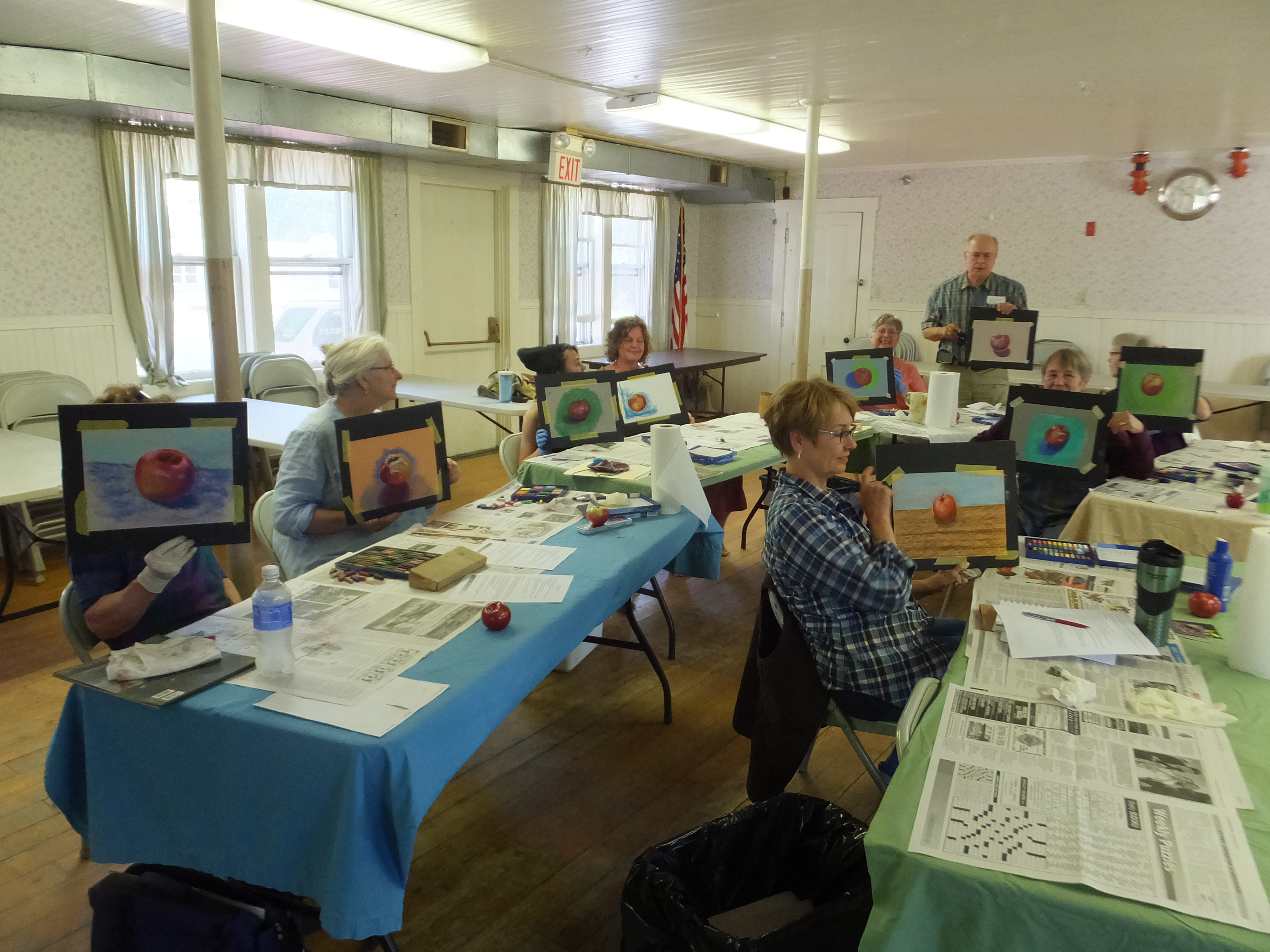
One exercise we do as a warm-up is to have the students paint an apple. Here is a photo of the most recent class and their apple paintings.

June '15 art class #2

As with any of the classes, there are a couple of students who clearly are not beginners. And a couple of students who struggle more than average. But they have all made fine art. Every single one has a vision: every apple is different….even if all the apples came out of the same bag!

Posted in Uncategorized | Tagged , , , , , , , , , , , | 1 Comment

Dreaming of Art

I have finished two new paintings. It feels good to be back to painting, even though I am not fully recovered yet. Here’s the first:

029

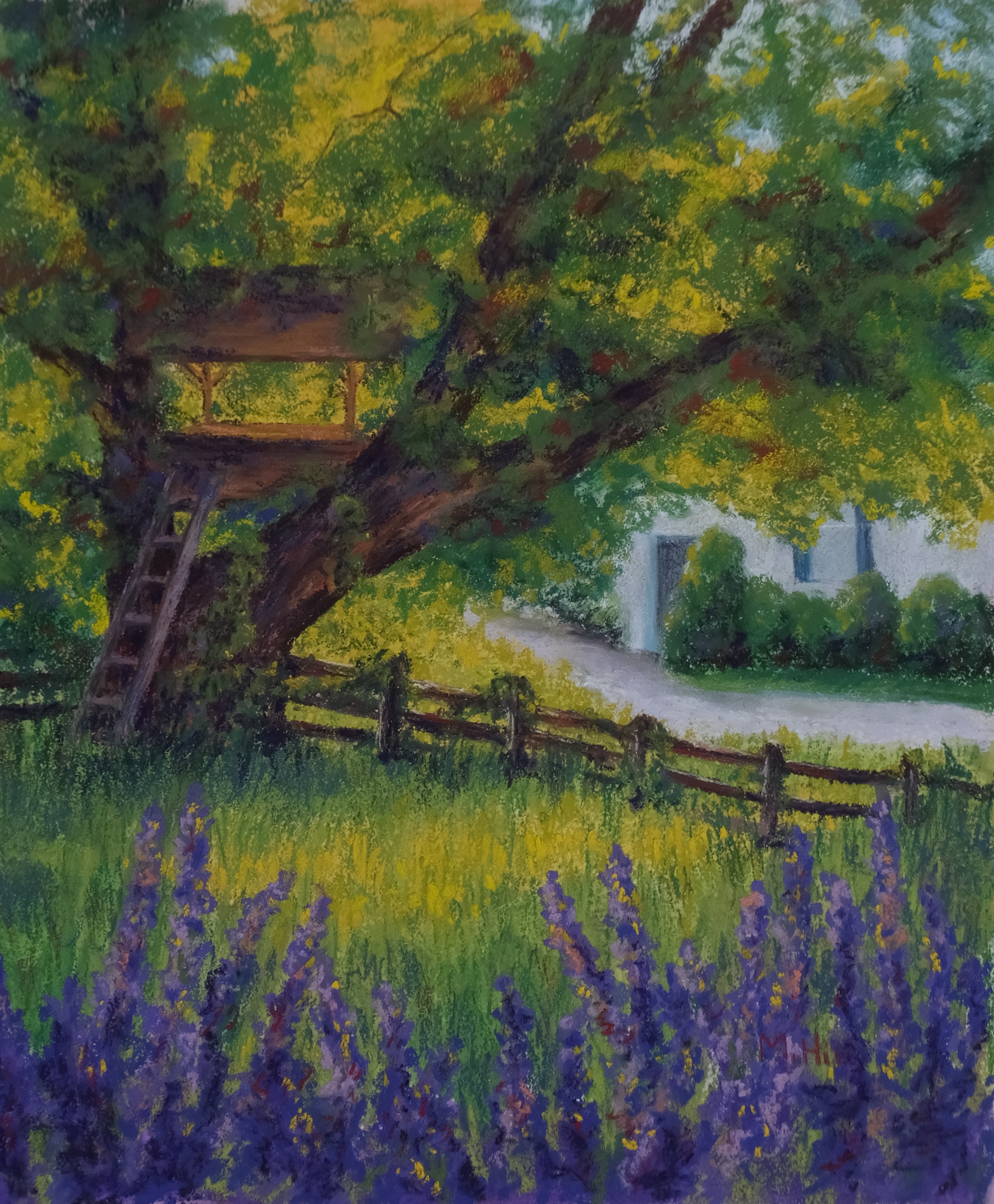
I worked from a photo, which was not too different from the painting. How fun to see that treehouse in that wide, generous, gracious old tree! The sun was backlighting the tree, making it golden and magical. And the lupines in front added a kind of generous and almost careless beauty. It’s every child’s enchanted world. I decided to call it “Wanna Play?” to emphasize that feeling of invitation.

Most of the image for the second painting came to me in a dream! Here it is:

037

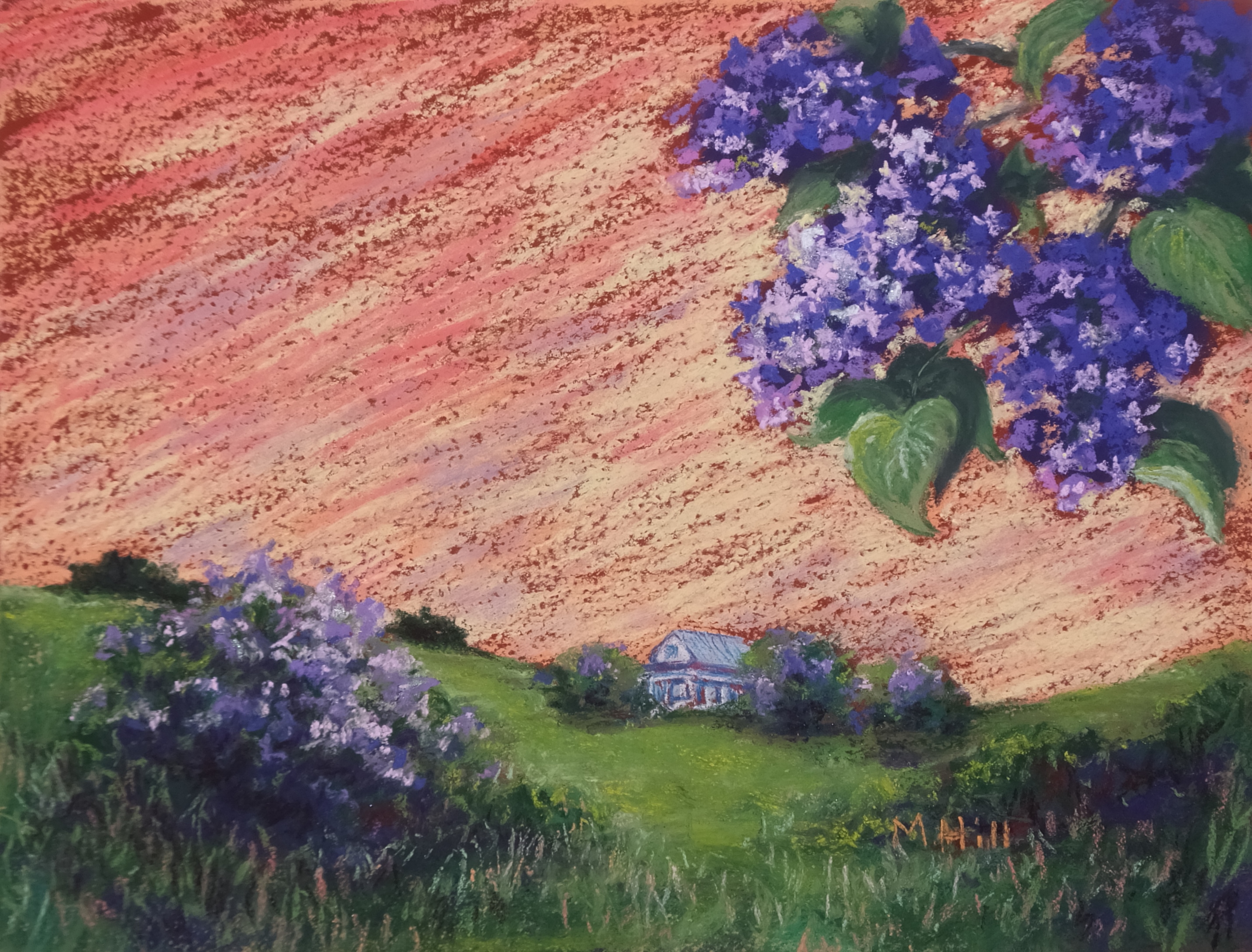
Just before waking, I saw the sky much as you see it here, a soft peachy orange streaked with orange-red. And in the upper corner, a bunch of lilacs. I had a vague sense of green below without detail. So as I thought about how I would shape the painting, I decided to add a farmhouse in the distance surrounded by lilac bushes, with another lilac bush in the middle foreground. They are there, really, just to complete the scene. There is something I find mysterious and haunting about this image. Do you? I suppose that I would, given that I dreamed it!

One thing I noticed after waking about the image is that its colors make up a perfect color triad: orange-green-purple. If you think of a color wheel, the colors go around in a circle. It’s red, orange, yellow, green, blue, purple, returning to red. A triad is red-yellow-blue, or orange-green-purple, or the same thing with any of the in-between colors. I doubt I would have done this if I had been awake!

Throughout my life, I have occasionally, although rarely, had dreams that were a kind of gushing forth of creativity. I remember dreaming of many, many mandalas, each different. Or a collection of small clay figures of fantastic animals. Or decorated eggs in beautiful colors. I would awaken in amazement, thinking, “I made all that!” In the dream, they were just there; awake, I realized that they had come from me. I have not had a dream like that since I started painting, using my creativity. But I wonder whether, as with “Sky Lilacs,” I will get more images from the night?

Posted in Uncategorized | Tagged , , , , , , , , | 3 Comments

The Nature of Creativity


It’s been some time since I posted, but I have a good reason: I got pneumonia! Apparently it is typical of the illness to need weeks to recover, even after the bug itself has been knocked out by antibiotics. Who knew? Not me. I have been very fatigued and portion out my limited energy in small tasks punctuated by periods of rest.

One thing that has been interesting to notice is that until this week, I have been unable to paint. I have had the energy to do the dishes or make lunch, so why not paint? After all, it can be done sitting down and requires very little physical activity. But the energy of the spirit required is significant, and it is not available when I am as sick as I’ve been.

Noticing that made me curious about the nature of that energy. Certainly part of it is focus and concentration. An artist friend calls painting her “brain rest,” not because it is restful, but because when you are painting you really cannot think of anything else. Your mind is totally occupied with the artistic decisions you are making virtually every second: is this color right? Should this be darker? Are these shapes harmonious? How does this work with what I already have on the paper?

Part of it, however, is something more ineffable. It’s the thing that I referred to as the “energy of the spirit.” It’s the essential creative force. I am reading “The Gift” by Lewis Hyde. I just started the book and I am guessing you will hear more about it in this blog, because already it seems unusually insightful. Here’s what he says about creating:

“We also speak rightly of intuition or inspiration as a gift. As the artist works, some portion of his creation is bestowed upon him. An idea pops into his head, a tune begins to play, a phrase comes to mind, a color falls into place on the canvas. Usually, in fact, the artist does not find himself engaged or exhilarated by the work, nor does it seem authentic, until this gratuitous element has appeared, so that along with any true creation comes the uncanny sense that “I,” the artist, did not make the work. “Not I, not I, but the wind that blows through me,” says D.H. Lawrence.”

I completely understand what he is expressing here. I felt the same thing as a writer, and I feel it as an artist. In that sense, the heart of creativity is the ability to open a channel to the “not I,” to the gift of creation. That is what comprises the real energy needed for painting. That is what art is all about, and it is not a small thing. Inviting the muse is the real “work” of art; the rest is secondary. It is what costs more than I could spend when I was most ill, and it is also what is most gratifying about making art. It is a connection to the sacred.

Posted in Uncategorized | 3 Comments